Can you afford to let the IRS levy your bank account or garnish your wages? That is what could happen if you owe back taxes and avoid their attempts to contact you.
IRS collection activities are negative events and represent anything but freedom, and therefore should be avoided. You must be proactive and take action to avoid IRS collection measures such as wage garnishments, bank account levies, property seizures, and liens placed on your property. It is important to know what the IRS is capable of doing. Most people find this knowledge a helpful motivator to stay on track with the tax resolution process. If the collection process has already started you should still proceed through the tax resolution process quickly and accurately to start resolving your tax problems on your terms rather than simply accepting defeat and allowing the IRS to control your financial life.
What does the IRS typically attempt to levy?
The IRS may intent to levy any federal payments due, retirement benefits, Social Security benefits, wages, or employee travel advances or reimbursements. The IRS can also levy property such as real estate, automobiles, business assets, bank accounts, wages, commissions, and other income. A levy is a seizure of property. The IRS will try to levy assets unless you TAKE ACTION. Why allow the IRS or any creditor to take control of your assets on their terms? If you owe taxes you need to pay them (or at least come up with some type of tax resolution alternative). However, you need to have a plan to pay them on your terms and not the terms of the IRS.
The IRS may involuntary collect the tax debt owed to them through different types of levies. A levy is served after the IRS has exhausted all other collection efforts to encourage taxpayer compliance. Levies commonly attach a taxpayer’s bank account, salary and wages, and/or business accounts receivable.
The IRS is required to release levies in several circumstances, including:
• The levy is creating an economic hardship.
• The taxpayer agrees to make an Installment Agreement.
• The liability is no longer owed.
• The 10-year statutory collection period has expired.
• The levy was wrongfully served.
• An Offer in Compromise is accepted for review.
The two circumstances most often utilized to request a levy release are when the levy is creating an economic hardship or when the taxpayer agrees to make an Installment Agreement. In both of these situations, the taxpayer must provide a Collection Information Statement for Individuals and Self-Employed Individuals (Form 433-A) and/or Collection Information Statement for Businesses (Form 433-B). To obtain a levy release, the taxpayer must also file all required tax returns and be current in estimated payments or Federal Tax Deposits, if required.
The IRS usually will not release a levy until the taxpayer has proposed a solution to the delinquent tax problem and demonstrated that they will remain in compliance with future obligations. In certain circumstances, the IRS may release a levy if the taxpayer promises missing tax returns or financial information by a fixed date, but this cannot be counted on. It is always best if the taxpayer can get all of the needed documentation before contacting the IRS for a release of levy.
In conclusion, if you are facing the possibility of an IRS levy it is always in your best interests to take action. Do not avoid the tax problem. A tax resolution plan is a proactive strategy that will help you resolve tax debt problems the best way possible for your situation.
Contact LifeSpan Financial Planning at 877-TAX-9110 if you are interested in finding out more about using a Tax Resolution Plan to overcome tax problems.
Showing posts with label tax debt. Show all posts
Showing posts with label tax debt. Show all posts
Wednesday, October 7, 2009


Tuesday, September 22, 2009
Creating a Personal Spending Plan
The definition of insanity may be doing the same things over and over again and expecting different results. I think the key defining element of seeking financial change (and eliminating insane amounts of debt) is doing the right things over and over again and actually getting positive results. Spending with a plan is the right thing to do, and it must be done over and over again.
The creation of a personal spending plan is one of the most important steps of the tax resolution process. A personal spending plan is also the foundation for achieving financial freedom. On the surface a spending plan or budget is extremely basic. Most people do not even have a simple budget much less a spending plan to guide their financial decisions. The purpose of this tax resolution step is to create a personal spending plan that will help you make sure that your money is working for you the best ways possible. Spending plans are also needed to resolve your tax debt and reach your other life planning goals.
A budget is generally defined as:
a) an itemized summary of estimated or intended expenditures for a given period along with proposals for financing them,
b) a systematic plan for the expenditure of a usually fixed resource, such as money or time, during a given period, and
c) the total sum of money allocated for a particular purpose or period of time.
When used as a verb the word budget means to plan in advance the expenditure of something. These definitions each focus on the action of planning. Budgeting is defined as estimated projection of the amount of certain expenses. During the tax resolution process you should use the word budget as a verb and take action. Tell your money where you want it to go rather than trying to figure out where it all went or worse, spending more than you have available and relying on credit cards and debt to get you through the month.
Unfortunately, most people approach the budgeting process the wrong way and do things backwards. They use a legal pad, spreadsheet or budgeting software and track where spending occurred across various categories (food, utilities, credit card bills, etc.). This is a great way to see where your money went during the previous month. But it is a horrible way to plan where your money will go in the future. During the previous step we analyzed where your money has been going in the past. Going forward, you should use the information gathered during the cash flow analysis to create a spending plan or budget.
The budgeting process is often misunderstood because it is typically viewed in a negative manner by the people who need one the most. We have discussed at length how many individuals in debt display problematic financial behaviors. One of the biggest problem behaviors is trying to manage personal finances without a plan. The lack of a personal spending plan or budget is common in the majority of people with tax problems. Many people are resistant to change when it comes to budgeting. Some tax resolution clients view a budget as a form of constraint that inhibits freedom. This is ironic because a personal spending plan will actually lead to financial freedom if used consistently.
Every single household spending plan is unique and each person will be presented with his or own set of challenges. Do not expect your personal spending plan to work perfectly the first time around. It may take a few months to figure this process out. This is normal. Whatever happens on a month to month basis, DO NOT QUIT and NEVER allow frustration to get in your way. Remember that the LifeSpan Process of Tax Resolution and Financial Freedom requires you to take action to replace negative financial behaviors with positive alternatives. The old way of doing things got you into this mess. Replace the old way with a new and improved way of handling your personal finances.
The creation of a personal spending plan is one of the most important steps of the tax resolution process. A personal spending plan is also the foundation for achieving financial freedom. On the surface a spending plan or budget is extremely basic. Most people do not even have a simple budget much less a spending plan to guide their financial decisions. The purpose of this tax resolution step is to create a personal spending plan that will help you make sure that your money is working for you the best ways possible. Spending plans are also needed to resolve your tax debt and reach your other life planning goals.
A budget is generally defined as:
a) an itemized summary of estimated or intended expenditures for a given period along with proposals for financing them,
b) a systematic plan for the expenditure of a usually fixed resource, such as money or time, during a given period, and
c) the total sum of money allocated for a particular purpose or period of time.
When used as a verb the word budget means to plan in advance the expenditure of something. These definitions each focus on the action of planning. Budgeting is defined as estimated projection of the amount of certain expenses. During the tax resolution process you should use the word budget as a verb and take action. Tell your money where you want it to go rather than trying to figure out where it all went or worse, spending more than you have available and relying on credit cards and debt to get you through the month.
Unfortunately, most people approach the budgeting process the wrong way and do things backwards. They use a legal pad, spreadsheet or budgeting software and track where spending occurred across various categories (food, utilities, credit card bills, etc.). This is a great way to see where your money went during the previous month. But it is a horrible way to plan where your money will go in the future. During the previous step we analyzed where your money has been going in the past. Going forward, you should use the information gathered during the cash flow analysis to create a spending plan or budget.
The budgeting process is often misunderstood because it is typically viewed in a negative manner by the people who need one the most. We have discussed at length how many individuals in debt display problematic financial behaviors. One of the biggest problem behaviors is trying to manage personal finances without a plan. The lack of a personal spending plan or budget is common in the majority of people with tax problems. Many people are resistant to change when it comes to budgeting. Some tax resolution clients view a budget as a form of constraint that inhibits freedom. This is ironic because a personal spending plan will actually lead to financial freedom if used consistently.
Every single household spending plan is unique and each person will be presented with his or own set of challenges. Do not expect your personal spending plan to work perfectly the first time around. It may take a few months to figure this process out. This is normal. Whatever happens on a month to month basis, DO NOT QUIT and NEVER allow frustration to get in your way. Remember that the LifeSpan Process of Tax Resolution and Financial Freedom requires you to take action to replace negative financial behaviors with positive alternatives. The old way of doing things got you into this mess. Replace the old way with a new and improved way of handling your personal finances.
Wednesday, July 29, 2009
Tax Resolution: Embracing the Need for Change

As people with tax or other financial problems embark on their tax and financial planning missions they need to embrace the idea of change. Dealing with tax problems can be a significant challenge. Tax resolution planning requires you to take a different approach to managing taxes and personal finances. The tax resolution process may be difficult and frustrating at times and you should always prepare for and expect minor setbacks. If you take the steps one at a time and prepare to take control of your life as it relates to money you will be able to obtain meaningful change.
Taking Action: Elements of Change
1. Readiness to change
2. Barriers to change
3. Expect setbacks
The concept of tax resolution planning involves taking action. If you want to change your financial life and get out of tax debt you have to take action. You have to want to change and be ready to accept it with courage and a positive attitude. Improving your financial well being requires a constant pursuit of meaningful change in all aspects of your life.
Many barriers to change exist along life’s journey no matter what the challenge. In the tax and financial planning world these barriers could be procrastination and fear. Other obstacles such as lack of support or marital discord may also stand in the way of change. Whatever your personal barriers are you need to go ahead and accept the fact that there will be obstacles. You should expect to incur setbacks and prepare for them. This does not mean that you should accept failure. You simply need to prepare for the minor setbacks and never allow them to stop you on the journey to financial freedom.
Assessing the Change Process
Behavior change is an ongoing process and in theory progresses through a series of stages. These theoretical stages were introduced by James Prochaska, Ph.D. and are generally referred to as the Transtheoretical Model of Change (Stages of Change Theory). I know that is a big word. Do not focus on it as much as the importance of assessing where you are in the change process while seeking ways to resolve tax problems. As you progress through the Tax Resolution Steps (and then focus on the Steps to Financial Freedom) always keep in mind as to which stage you are in.
1. Pre-contemplation- person does not intend to take action in the next six months
Example: IRS letters are completely ignored, unwilling to discuss the need to file past due tax returns, continue to spend more than you earn, no personal spending plan, may not even realize a tax problem exists
2. Contemplation- person intends to take action in the next six months
Example: Realizes the need to deal with tax issue, understands the need for a tax and financial plan, lack of awareness where to turn to for help and guidance, do not understand the financial mess they are in, tried to create a budget in the past but failed, defensive (pulled into action before they were ready)
3. Preparation- person intends to take action in the next 30 days
Example: Researching available tax resolution options, deciding whether or not to seek professional help, beginning stages of organization, gathering tax and financial documents
4. Action- person has taken action, but for less than six months, hardest most demanding step, make a commitment to place the tax resolution and financial planning process as the top priority for the next six months,
Example: Seeking help with tax resolution issues, creating a personal spending plan, determining the best particular tax resolution alternative, working the steps of tax resolution and financial freedom
5. Maintenance- person has take action for more than six months, stress is the top reason people regress at this stage, there is a need to create positive choices or alternatives to deal with stress (social support/talking, exercise, relaxation, following a financial "life plan")
Example: Staying current with IRS payments, filing future tax returns on time, reviewing personal spending plan on an ongoing basis, communicating regularly with spouse about money
6. Termination- person will not revert to self-defeating, self-destructive financial behaviors; learning new behaviors and making them a part of who you are, similar to the challenge that people are faced with addiction
Example: Tax freedom is achieved by paying off the tax liabilities. Future tax and financial problems are avoided by consistently using positive financial behaviors. Developed the ability to take control of money and focus on other parts of life.
The LifeSpan Process of Tax Resolution and Financial Freedom promotes the termination of problematic financial behaviors. The best way to do this is to learn better alternatives such as planning, eliminating debt, avoiding debt, saving and investing. This process of change eliminates debt faster and reduces the likelihood of future tax or financial struggles.
Monday, June 22, 2009
Tax Debt Problems: Finding the Ideal Solution
Do you owe back taxes to the IRS?
Are you behind with filing tax returns?
Is dealing with tax matters becoming frustrating or overwhelming?
Or…
Are you compliant with your tax obligations but would like to establish a plan to minimize the impact of future income taxes?
If you have tax problems, what is the ideal solution for your tax struggles? The answer depends on the “big picture” of your financial situation. There is no one option that is the best choice for each person. A one size fits all approach does not work with tax resolution. The IRS simply wants to ensure that you pay your tax obligation and they will take various measures to make sure you do so according to their terms. It is up to you, the taxpayer (with some professional guidance), to make smart financial decisions when choosing among your tax resolution alternatives. Keep in mind that the IRS is essentially the accounts receivables department of the U.S. Government. Their job is to make sure that everyone that should pay taxes does. If a taxpayer is not compliant with IRS procedures they have the authority to collect.
The Internal Revenue Service does not necessarily care that you choose the best tax resolution option available. They simply want to ensure that you pay your tax obligation and they will take various measures to make sure you do so according to their terms. It is up to you, the taxpayer, to make smart financial decisions when choosing among your tax resolution alternatives.”
The bottom line is that avoidance is not an option. Take control of your tax problems, and while you are doing so assume control of something more important- your total financial situation. There are many options available during your quest to deal with resolving a tax liability. However, taking control of your life by establishing a financial plan is NOT an option…it should be viewed as a requirement if you truly want to reduce your financial stress and get on with your life on your terms (not the IRS’s). Remember, the IRS is interested in one thing during the collections process and that is collecting taxes that are past due.
If you are faced with the task of dealing with a past due tax liability, you need to understand how to organize your financial life in order to deal with the IRS in the most effective manner. This means putting your goals and objectives first and being proactive. Engaging in the financial planning process is your best option as you begin the journey to tax resolution with the IRS. Tax debt inhibits freedom. It distracts you from other more important goals and objectives.
Debt is Dumb. Tax Debt is even Dumber if not dealt with immediately. Resolving tax debt without a plan is not a smart decision. Tax resolution requires a plan. The tax and financial planning process is the solution to resolve tax problems.
Scott M. Spann, CFP(R), EA, MA
Financial Life Planner
LifeSpan Financial Planning, LLC
(877) 829-9110
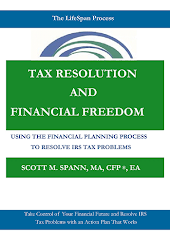
For more information on the LifeSpan Process of Tax Resolution and Financial Freedom, contact Scott toll-free at 877-TAX-9110. LifeSpan is currently offering complimentary copies of the book "Tax Resolution and Financial Freedom" to everyone that schedules a free Tax Resolution Analysis before July 4th.
Are you behind with filing tax returns?
Is dealing with tax matters becoming frustrating or overwhelming?
Or…
Are you compliant with your tax obligations but would like to establish a plan to minimize the impact of future income taxes?
If you have tax problems, what is the ideal solution for your tax struggles? The answer depends on the “big picture” of your financial situation. There is no one option that is the best choice for each person. A one size fits all approach does not work with tax resolution. The IRS simply wants to ensure that you pay your tax obligation and they will take various measures to make sure you do so according to their terms. It is up to you, the taxpayer (with some professional guidance), to make smart financial decisions when choosing among your tax resolution alternatives. Keep in mind that the IRS is essentially the accounts receivables department of the U.S. Government. Their job is to make sure that everyone that should pay taxes does. If a taxpayer is not compliant with IRS procedures they have the authority to collect.
The Internal Revenue Service does not necessarily care that you choose the best tax resolution option available. They simply want to ensure that you pay your tax obligation and they will take various measures to make sure you do so according to their terms. It is up to you, the taxpayer, to make smart financial decisions when choosing among your tax resolution alternatives.”
The bottom line is that avoidance is not an option. Take control of your tax problems, and while you are doing so assume control of something more important- your total financial situation. There are many options available during your quest to deal with resolving a tax liability. However, taking control of your life by establishing a financial plan is NOT an option…it should be viewed as a requirement if you truly want to reduce your financial stress and get on with your life on your terms (not the IRS’s). Remember, the IRS is interested in one thing during the collections process and that is collecting taxes that are past due.
If you are faced with the task of dealing with a past due tax liability, you need to understand how to organize your financial life in order to deal with the IRS in the most effective manner. This means putting your goals and objectives first and being proactive. Engaging in the financial planning process is your best option as you begin the journey to tax resolution with the IRS. Tax debt inhibits freedom. It distracts you from other more important goals and objectives.
Debt is Dumb. Tax Debt is even Dumber if not dealt with immediately. Resolving tax debt without a plan is not a smart decision. Tax resolution requires a plan. The tax and financial planning process is the solution to resolve tax problems.
Scott M. Spann, CFP(R), EA, MA
Financial Life Planner
LifeSpan Financial Planning, LLC
(877) 829-9110
For more information on the LifeSpan Process of Tax Resolution and Financial Freedom, contact Scott toll-free at 877-TAX-9110. LifeSpan is currently offering complimentary copies of the book "Tax Resolution and Financial Freedom" to everyone that schedules a free Tax Resolution Analysis before July 4th.
Monday, June 8, 2009
The Importance of Eliminating Debt from your Life
The presence of debt problems affects more than just the individual in debt. Tax and consumer debt can create additional strains on relationships with a spouse or other family members. Similar to most problems that go unaddressed over long periods of time, financial problems related to debt will compound if not eventually dealt with. This is undoubtedly the case with past due tax liabilities and related penalties and interest as well as other forms of problematic debt (e.g., credit cards, installment loans, etc.).
Biopsychosocial Impact of Debt (a.k.a. The Triple Whammy)
The presence of debt affects more than just the wallet. Debt problems can also create an increased risk of health, psychological, and social pressures. Engaging oneself in a debt reduction plan will do more than improve the finances. The following problems are associated with debt.
• Health Problems- Being in debt is associated with an increased risk of digestive track issues, migraines, and even heart attack. Other related problems are high blood pressure, insomnia, lower back pain or tension, and concentration problems.
• Psychological Problems- Anxiety, depression
• Social Problems- Marital tension and debt stress have a negative impact on relationships in general, trouble focusing on work can also result in poor productivity and increased problems at your workplace
A life without debt may seem difficult to imagine if you are one of the millions of Americans struggling financially. Debt will not go away on its own. Take action and create a debt management plan that puts you in control of your financial future.
Biopsychosocial Impact of Debt (a.k.a. The Triple Whammy)
The presence of debt affects more than just the wallet. Debt problems can also create an increased risk of health, psychological, and social pressures. Engaging oneself in a debt reduction plan will do more than improve the finances. The following problems are associated with debt.
• Health Problems- Being in debt is associated with an increased risk of digestive track issues, migraines, and even heart attack. Other related problems are high blood pressure, insomnia, lower back pain or tension, and concentration problems.
• Psychological Problems- Anxiety, depression
• Social Problems- Marital tension and debt stress have a negative impact on relationships in general, trouble focusing on work can also result in poor productivity and increased problems at your workplace
A life without debt may seem difficult to imagine if you are one of the millions of Americans struggling financially. Debt will not go away on its own. Take action and create a debt management plan that puts you in control of your financial future.
Monday, April 6, 2009
What is the “LifeSpan Process of Tax Resolution and Financial Freedom”?
I chose the name LifeSpan Financial Planning, LLC for my financial counseling and tax planning practice for a specific reason. An effective financial plan should do more than simply help individuals and families reach their financial goals. In my opinion, the planning process should include a holistic approach that addresses life planning goals as well as concepts of money management. A “LifeSpan Plan” helps define what is important to each unique individual and addresses underlying dreams and visions across the entire lifespan. It also helps individuals and families find ways to maximize the resources available to accomplish these lifelong ambitions. My main goal as a professional has always been to help my clients achieve important life goals and understand the role that money plays in their lives.
Financial planning is both an art and a science. Life planning is a relatively new approach that is usually seen as the art or human side of financial planning. The process of life planning is used to help people discover their deepest and most profound lifelong goals. This can be accomplished through a process of self-awareness and inquiry. If major obstacles such as significant tax debt or poor financial management exist it is difficult to focus on life and financial planning goals.
Tax problems create a need for tax and financial planning strategies that will solve tax issues the best way possible. On the surface it would appear to be a fairly simple approach. This assumption is based on the belief that most people deal with money in a rational way. The reality is that there are many cognitive-behavioral factors that operate as barriers to change in the lives of people with tax problems. These tax liabilities are significant obstacles that delay or prevent people from accomplishing their innermost dreams in life.
Tax Resolution and Financial Freedom is a two-stage process that combines two primary areas of focus: tax resolution and financial planning. Tax Resolution and Financial Planning are typically viewed as separate processes. This system simply does not work due to the sometimes conflicting approaches that do not generally work together. You must start the tax resolution process to be able to progress into comprehensive financial planning. The line between the two stages should be viewed as a barrier that stops people from achieving financial freedom. Tax resolution must be achieved prior to working to accomplish most financial planning goals. Otherwise, you will keep running into the brick wall that blocks the path to financial freedom.
As a whole, the “Tax Resolution and Financial Freedom Process” can be overwhelming and confusing. If you break the process into two parts it becomes a more manageable process. A strong need exists to create a new paradigm for dealing with tax problems. Debt is dumb. Tax debt is dumber. Trying to deal with tax and financial problems without a strategic plan is pure stupidity. Good intentions without direction will most likely lead to eventual failure. This step by step plan has been created to provide the direction needed to address tax problems with a plan.
Financial planning is both an art and a science. Life planning is a relatively new approach that is usually seen as the art or human side of financial planning. The process of life planning is used to help people discover their deepest and most profound lifelong goals. This can be accomplished through a process of self-awareness and inquiry. If major obstacles such as significant tax debt or poor financial management exist it is difficult to focus on life and financial planning goals.
Tax problems create a need for tax and financial planning strategies that will solve tax issues the best way possible. On the surface it would appear to be a fairly simple approach. This assumption is based on the belief that most people deal with money in a rational way. The reality is that there are many cognitive-behavioral factors that operate as barriers to change in the lives of people with tax problems. These tax liabilities are significant obstacles that delay or prevent people from accomplishing their innermost dreams in life.
Tax Resolution and Financial Freedom is a two-stage process that combines two primary areas of focus: tax resolution and financial planning. Tax Resolution and Financial Planning are typically viewed as separate processes. This system simply does not work due to the sometimes conflicting approaches that do not generally work together. You must start the tax resolution process to be able to progress into comprehensive financial planning. The line between the two stages should be viewed as a barrier that stops people from achieving financial freedom. Tax resolution must be achieved prior to working to accomplish most financial planning goals. Otherwise, you will keep running into the brick wall that blocks the path to financial freedom.
As a whole, the “Tax Resolution and Financial Freedom Process” can be overwhelming and confusing. If you break the process into two parts it becomes a more manageable process. A strong need exists to create a new paradigm for dealing with tax problems. Debt is dumb. Tax debt is dumber. Trying to deal with tax and financial problems without a strategic plan is pure stupidity. Good intentions without direction will most likely lead to eventual failure. This step by step plan has been created to provide the direction needed to address tax problems with a plan.
Thursday, April 2, 2009
10 Common Tax Resolution Myths
If you are seeking professional guidance with a tax resolution issue you should pay attention to these common myths that some tax representation firms perpetuate through various media outlets in the form of television and internet marketing. Always remember there is a large group of ethical tax professionals available to assist people with tax problems. However, it is necessary to separate fact from fiction when determining the best tax resolution plan.
MYTH: The IRS offers a “one time only” opportunity to resolve your tax liabilities.
FACT: The impression that tax resolution is a one shot deal is completely false. This “act now before you lose your chance” approach implies that the Offer in Compromise (OIC) program is a new service with the IRS. OIC’s were initially introduced in the 1990’s in order to increase voluntary tax compliance, reduce taxpayer burden, and improve IRS productivity. The Tax Increase Prevention and Reconciliation Act of 2005 made major changes to the program and altered the rules for lump-sum offers and periodic-payment offers.
These marketing techniques are intended to encourage you to “act now” and sign up for a service. Many tax resolution clients actually become repeat clients and contact the same firm or a different tax resolution company. Is this the client’s fault or a problem with the tax professional? Most typically the client is ultimately responsible for changing negative financial behaviors. However, it is up to the tax professional to provide as much education and guidance as possible to keep clients out of future tax problems. Although tax resolution is not a one-time opportunity, delinquent taxpayers should view it as a one-time only event that needs to be dealt with correctly the first time.
MYTH: If someone owes taxes to the IRS and has negative cash flow they should easily qualify for an Offer in Compromise.
FACT: The IRS has the authority to settle or compromise federal tax liabilities by accepting less than full payment under certain circumstances. OIC’s are generally accepted if the taxpayers can establish that they have either no means of paying the tax or do not actually owe the tax. The IRS calculates a taxpayer’s collection potential by looking at equity in assets and monthly disposable income using a special formula that only includes “allowable” expenses based on national and local standards.
A taxpayer can be living paycheck to paycheck with significant tax and consumer debt and the IRS may still have a legal right to collect on the entire amount owed. This is a common situation that many clients are faced with as they enter the tax resolution process. Cash flow problems also stress the urgent need to change overall financial behaviors and develop a coordinated plan to achieve financial freedom.
MYTH: It is best to work with a large tax representation firm that has ex-IRS agents working for them.
FACT: Enrolled Agents (EAs), Certified Public Accountants (CPAs), and attorneys are the only professionals who have demonstrated special competence in tax matters and have earned the privilege of practicing or representing clients before the IRS. Enrolled Agents, like attorneys and CPAs, are unrestricted as to which taxpayers they can represent, what types of matters they can handle, and in which IRS offices they can practice. Past service and technical experience with the IRS is one category that can qualify a person to become an Enrolled Agent.
The most important thing to look for when seeking professional help is integrity and expertise in tax resolution planning. Note the word “planning”. This is an essential element that tax resolution professionals should be focusing their attention. IRS experience definitely helps professionals understand the tax representation process. It does not always guarantee expertise in the important area of tax resolution planning.
MYTH: If someone is drowning in debt he or she should easily be able to qualify for “pennies on the dollar” resolution.
FACT: First of all, avoid any companies that use “pennies on the dollar” advertising or provide guarantees that you will qualify for an Offer in Compromise. The OIC program is the most widely advertised and promoted tax resolution technique marketed on television and the internet. OIC’s are also grossly oversold to people experiencing significant cash flow stress due to broader financial problems related to consumer debt. If you have the assets or future income potential to pay off your tax debt over time you will not qualify for an Offer in Compromise (except in special circumstances). The IRS only uses “allowable expenses” in the tax resolution analysis. Certain expenses such as credit cards, tuition, retirement contributions, and cable television bills are not allowable expenses during the tax resolution process.
MYTH: Large tax representation firms can perform their services more efficiently and at a lower cost than local Enrolled Agents, CPAs, or tax attorneys.
FACT: Costs vary from firm to firm. The level of customer service and professionalism also varies. If you take action and actively participate in the “LifeSpan Process of Tax Resolution and Financial Freedom” you will know where to find the most cost-effective solutions to your tax problems, whether or not you choose to use the services of professional tax representation.
MYTH: Tax resolution companies have a regulatory body that provides them with a specific set of guidelines and a professional code of ethics.
FACT: Currently there is no existing regulatory body to protect consumers doing business with tax representation firms. Most individual practitioners such as CPAs, EAs, and attorneys have professional standards they must uphold, but tax representation firms as a whole do not have anything other than legal precedent and IRS policies and procedures to guide them. The IRS issued a consumer alert to taxpayers in 2004 advising them to “beware of promoters’ claims that tax debts can be settled for “pennies on the dollar” through the Offer in Compromise Program”.
MYTH: Tax resolution firms represent me by appearing directly in front of the IRS on my behalf.
FACT: The majority of tax representation work occurs over the phone, internet, and through regular mail correspondence. Effective tax representation most often avoids the need for a one on one meeting with the IRS or appearances in Tax Court.
MYTH: The IRS may have forgotten about you if they do not contact you after a few years of not filing or paying taxes.
FACT: One of the biggest problems with the IRS collection process is the fact that it can often take years before the collection process actually begins. The tax system in our country is based on voluntary compliance. If you let months and years pass the IRS will eventually track you down, and you will be hit with enormous penalties and interest. This cycle of procrastination and avoidance only creates a bigger tax and financial problem. Delays and avoidance behaviors only intensify tax problems. Besides, if you owe taxes then you need to get the problem resolved quickly. Not paying taxes is essentially stealing from the federal government and all of the honest Americans who paid their taxes. Ignoring the problem will only make it worse.
MYTH: Taxes and finances are too confusing to understand. Besides, individuals are not capable of resolving tax problems by dealing with the IRS on their own.
FACT: Financial ignorance can be overcome through action and some basic education. Tax resolution and financial planning is 75% behavioral and 25% knowledge and technical expertise. Everyone has the ability to deal directly with the IRS themselves with proper guidance and preparation. Professionals play an important role in the tax resolution process. The ultimate responsibility lies with the individual to make smart financial decisions. Knowledge will only get you so far. You have to be able to take action and use financial knowledge to your benefit. Too many people with tax problems are paralyzed by fear because they do not understand basic concepts of money and taxes.
MYTH: If someone has a tax problem they do not need a financial plan.
FACT: This common misconception is the entire reason that the “Tax Resolution and Financial Freedom” process was created. Tax problems are most often the result of poor planning, economic hardships or emergencies, financial ignorance, fear, and procrastination. The only way to resolve tax problems and take control of your life as it relates to money is to establish and implement a tax and financial plan. Whether you call it financial planning or counseling the end result should always be an improved sense of direction when it comes to financial matters.
Subscribe to:
Posts (Atom)



 Posts
Posts