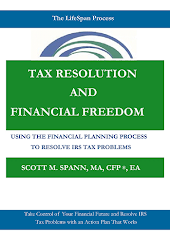
The Tax Resolution and Financial Freedom blog is dedicated to helping people find effective solutions to tax and financial problems. Each person defines the concept of tax and financial freedom in a unique manner. This blog addresses the importance of taking action and making smart financial decisions.
It is no surprise that most Americans dread April 15th when the deadline looms for filling out federal and state income tax returns. On the surface, learning the tax code can appear more complicated than learning a new language. In fact, sometimes I read the tax code and wonder if the IRS is speaking English.
Have you ever vowed to yourself at tax time that you will be better prepared "next year" only to experience the exact same frustration when next year arrives? It is becoming a popular New Year's resolution for people to promise themselves that they will do a better job at maintaining accurate records and getting organized, or that they will pay closer attention to possible tax-saving measures. Unfortunately, many people simply do not follow through with that commitment.
Engagement in the tax and financial planning process provides taxpayers with an opportunity to take control of their income tax concerns. Instead of being a typical taxpayer and waiting for the deadline to arrive, you should plan ahead and file your tax returns prior to the April 15th deadline. Most importantly, you should file those tax returns with confidence that you are in control of your financial destiny. You may even decide to go ahead and schedule your own deadline of March 15th or April 1st and hold yourself accountable to a self-imposed deadline to defeat the temptations of procrastination. If everything goes smoothly you should celebrate your step toward total tax and financial freedom.
Disclaimer: Please note that the term "tax freedom" does not mean you will likely ever be completely free from paying taxes in this country. However, tax freedom can be achieved by taking control of your tax situation and minimizing the impact of current and future taxes with a plan that works.
Whether or not you choose to use the services of a tax professional is a personal decision and depends on your individual level of confidence with tax and other financial matters. For most taxpayers with a history of recent tax and financial problems I suggest the use of professional tax preparation services for at least a couple of years. At a minimum you should at least use some type of tax preparation software to assist with the process. Turbo Tax, Tax Wise, and Tax Cut are some of the most popular software programs that my clients have used successfully to help prepare tax returns.
Tax planning is more than just trying to reduce your overall taxes. Income tax planning decisions should always be part of your overall financial life plan. Always coordinate tax planning with your comprehensive financial planning goals and objectives. If you are working with a CPA, EA, or other tax professional be sure that they are communicating with your financial planner or other financial advisory team members.
Holistic tax planning requires a deeper focus than just trying to lower taxes. Tax reduction is great. However, it is more meaningful when used in conjunction with bigger picture planning. If you have not done so already this year, take a few moments to review your income tax plan. Don't have a formal tax plan in place? It is not too late to start. Next tax season is not too far away and will be a lot more enjoyable for the taxpayers that take the time to prepare for April 15th throughout the course of the year.
If you are seeking professional guidance with a tax resolution issue you should pay attention to these common myths that some tax representation firms perpetuate through various media outlets in the form of television and internet marketing.Always remember there is a large group of ethical tax professionals available to assist people with tax problems.However, it is necessary to separate fact from fiction when determining the best tax resolution plan.
MYTH:The IRS offers a “one time only” opportunity to resolve your tax liabilities.
FACT:The impression that tax resolution is a one shot deal is completely false.This “act now before you lose your chance” approach implies that the Offer in Compromise (OIC) program is a new service with the IRS.OIC’s were initially introduced in the 1990’s in order to increase voluntary tax compliance, reduce taxpayer burden, and improve IRS productivity.The Tax Increase Prevention and Reconciliation Act of 2005 made major changes to the program and altered the rules for lump-sum offers and periodic-payment offers.
These marketing techniques are intended to encourage you to “act now” and sign up for a service.Many tax resolution clients actually become repeat clients and contact the same firm or a different tax resolution company.Is this the client’s fault or a problem with the tax professional?Most typically the client is ultimately responsible for changing negative financial behaviors.However, it is up to the tax professional to provide as much education and guidance as possible to keep clients out of future tax problems.Although tax resolution is not a one-time opportunity, delinquent taxpayers should view it as a one-time only event that needs to be dealt with correctly the first time.
MYTH:If someone owes taxes to the IRS and has negative cash flow they should easily qualify for an Offer in Compromise.
FACT:The IRS has the authority to settle or compromise federal tax liabilities by accepting less than full payment under certain circumstances.OIC’s are generally accepted if the taxpayers can establish that they have either no means of paying the tax or do not actually owe the tax.The IRS calculates a taxpayer’s collection potential by looking at equity in assets and monthly disposable income using a special formula that only includes “allowable” expenses based on national and local standards.
A taxpayer can be living paycheck to paycheck with significant tax and consumer debt and the IRS may still have a legal right to collect on the entire amount owed.This is a common situation that many clients are faced with as they enter the tax resolution process.Cash flow problems also stress the urgent need to change overall financial behaviors and develop a coordinated plan to achieve financial freedom.
MYTH:It is best to work with a large tax representation firm that has ex-IRS agents working for them.
FACT:Enrolled Agents (EAs), Certified Public Accountants (CPAs), and attorneys are the only professionals who have demonstrated special competence in tax matters and have earned the privilege of practicing or representing clients before the IRS.Enrolled Agents, like attorneys and CPAs, are unrestricted as to which taxpayers they can represent, what types of matters they can handle, and in which IRS offices they can practice.Past service and technical experience with the IRS is one category that can qualify a person to become an Enrolled Agent.
The most important thing to look for when seeking professional help is integrity and expertise in tax resolution planning.Note the word “planning”.This is an essential element that tax resolution professionals should be focusing their attention.IRS experience definitely helps professionals understand the tax representation process.It does not always guarantee expertise in the important area of tax resolution planning.
MYTH:If someone is drowning in debt he or she should easily be able to qualify for “pennies on the dollar” resolution.
FACT:First of all, avoid any companies that use “pennies on the dollar” advertising or provide guarantees that you will qualify for an Offer in Compromise.The OIC program is the most widely advertised and promoted tax resolution technique marketed on television and the internet.OIC’s are also grossly oversold to people experiencing significant cash flow stress due to broader financial problems related to consumer debt.If you have the assets or future income potential to pay off your tax debt over time you will not qualify for an Offer in Compromise (except in special circumstances).The IRS only uses “allowable expenses” in the tax resolution analysis.Certain expenses such as credit cards, tuition, retirement contributions, and cable television bills are not allowable expenses during the tax resolution process.
MYTH:Large tax representation firms can perform their services more efficiently and at a lower cost than local Enrolled Agents, CPAs, or tax attorneys.
FACT:Costs vary from firm to firm.The level of customer service and professionalism also varies.If you take action and actively participate in the “LifeSpan Process of Tax Resolution and Financial Freedom” you will know where to find the most cost-effective solutions to your tax problems, whether or not you choose to use the services of professional tax representation.
MYTH:Tax resolution companies have a regulatory body that provides them with a specific set of guidelines and a professional code of ethics.
FACT:Currently there is no existing regulatory body to protect consumers doing business with tax representation firms.Most individual practitioners such as CPAs, EAs, and attorneys have professional standards they must uphold, but tax representation firms as a whole do not have anything other than legal precedent and IRS policies and procedures to guide them.The IRS issued a consumer alert to taxpayers in 2004 advising them to “beware of promoters’ claims that tax debts can be settled for “pennies on the dollar” through the Offer in Compromise Program”.
MYTH:Tax resolution firms represent me by appearing directly in front of the IRS on my behalf.
FACT:The majority of tax representation work occurs over the phone, internet, and through regular mail correspondence.Effective tax representation most often avoids the need for a one on one meeting with the IRS or appearances in Tax Court.
MYTH:The IRS may have forgotten about you if they do not contact you after a few years of not filing or paying taxes.
FACT:One of the biggest problems with the IRS collection process is the fact that it can often take years before the collection process actually begins.The tax system in our country is based on voluntary compliance.If you let months and years pass the IRS will eventually track you down, and you will be hit with enormous penalties and interest.This cycle of procrastination and avoidance only creates a bigger tax and financial problem.Delays and avoidance behaviors only intensify tax problems.Besides, if you owe taxes then you need to get the problem resolved quickly.Not paying taxes is essentially stealing from the federal government and all of the honest Americans who paid their taxes.Ignoring the problem will only make it worse.
MYTH:Taxes and finances are too confusing to understand.Besides, individuals are not capable of resolving tax problems by dealing with the IRS on their own.
FACT:Financial ignorance can be overcome through action and some basic education.Tax resolution and financial planning is 75% behavioral and 25% knowledge and technical expertise.Everyone has the ability to deal directly with the IRS themselves with proper guidance and preparation.Professionals play an important role in the tax resolution process.The ultimate responsibility lies with the individual to make smart financial decisions.Knowledge will only get you so far.You have to be able to take action and use financial knowledge to your benefit.Too many people with tax problems are paralyzed by fear because they do not understand basic concepts of money and taxes.
MYTH:If someone has a tax problem they do not need a financial plan.
FACT:This common misconception is the entire reason that the “Tax Resolution and Financial Freedom” process was created.Tax problems are most often the result of poor planning, economic hardships or emergencies, financial ignorance, fear, and procrastination.The only way to resolve tax problems and take control of your life as it relates to money is to establish and implement a tax and financial plan.Whether you call it financial planning or counseling the end result should always be an improved sense of direction when it comes to financial matters.
Click the link above to visit the LifeSpan Tax Resolution website at www.taxresolutionplan.com. Call us toll-free at 1-877-TAX-9110 for more information on the LifeSpan Process of Tax Resolution and Financial Freedom.
LifeSpan Financial Planning, LLC
Scott M. Spann, CFP®, EA / Financial Life Planner
Welcome to the Tax Resolution and Financial Freedom Blog
This blog is designed to cover tax and financial planning topics related to tax resolution and financial freedom. Millions of Americans are struggling with problems related to debt. Tax debt is one of the most problematic forms of debt that more and more people are facing during times of economic crisis. In fact, even during good times millions of people struggle to make sense of the tax code in this country.
Dealing with tax problems can be a difficult and confusing process. If you have tax debt and you owe the Internal Revenue Service you need a plan that works. The ideal solution to resolving tax problems is to use an approach that combines tax debt resolution with basic concepts of financial planning. Most tax resolution plans fail to incorporate financial planning into the process of dealing with tax debt. A holistic tax and financial planning method is the best way to eliminate tax problems while also addressing unique financial life planning goals.
Scott is a CERTIFIED FINANCIAL PLANNER™ professional specializing in comprehensive financial planning. Scott has been providing financial planning advice for a diverse group of clients since 2000. He is a Fee-Only financial life planner practitioner with a specialized focus in areas of tax planning and financial life planning. Scott also specializes in investment planning, retirement planning, college planning, tax planning and incorporating life planning into the financial planning process. Scott is committed to the Fee-Only model of financial planning.




 Posts
Posts