Showing posts with label financial freedom. Show all posts

Wednesday, July 29, 2009

Tax Resolution: Embracing the Need for Change


As people with tax or other financial problems embark on their tax and financial planning missions they need to embrace the idea of change. Dealing with tax problems can be a significant challenge. Tax resolution planning requires you to take a different approach to managing taxes and personal finances. The tax resolution process may be difficult and frustrating at times and you should always prepare for and expect minor setbacks. If you take the steps one at a time and prepare to take control of your life as it relates to money you will be able to obtain meaningful change.

Taking Action: Elements of Change
1. Readiness to change
2. Barriers to change
3. Expect setbacks

The concept of tax resolution planning involves taking action. If you want to change your financial life and get out of tax debt you have to take action. You have to want to change and be ready to accept it with courage and a positive attitude. Improving your financial well being requires a constant pursuit of meaningful change in all aspects of your life.

Many barriers to change exist along life’s journey no matter what the challenge. In the tax and financial planning world these barriers could be procrastination and fear. Other obstacles such as lack of support or marital discord may also stand in the way of change. Whatever your personal barriers are you need to go ahead and accept the fact that there will be obstacles. You should expect to incur setbacks and prepare for them. This does not mean that you should accept failure. You simply need to prepare for the minor setbacks and never allow them to stop you on the journey to financial freedom.


Assessing the Change Process
Behavior change is an ongoing process and in theory progresses through a series of stages. These theoretical stages were introduced by James Prochaska, Ph.D. and are generally referred to as the Transtheoretical Model of Change (Stages of Change Theory). I know that is a big word. Do not focus on it as much as the importance of assessing where you are in the change process while seeking ways to resolve tax problems. As you progress through the Tax Resolution Steps (and then focus on the Steps to Financial Freedom) always keep in mind as to which stage you are in.

1. Pre-contemplation- person does not intend to take action in the next six months

Example: IRS letters are completely ignored, unwilling to discuss the need to file past due tax returns, continue to spend more than you earn, no personal spending plan, may not even realize a tax problem exists

2. Contemplation- person intends to take action in the next six months

Example: Realizes the need to deal with tax issue, understands the need for a tax and financial plan, lack of awareness where to turn to for help and guidance, do not understand the financial mess they are in, tried to create a budget in the past but failed, defensive (pulled into action before they were ready)

3. Preparation- person intends to take action in the next 30 days

Example: Researching available tax resolution options, deciding whether or not to seek professional help, beginning stages of organization, gathering tax and financial documents

4. Action- person has taken action, but for less than six months, hardest most demanding step, make a commitment to place the tax resolution and financial planning process as the top priority for the next six months,

Example: Seeking help with tax resolution issues, creating a personal spending plan, determining the best particular tax resolution alternative, working the steps of tax resolution and financial freedom

5. Maintenance- person has take action for more than six months, stress is the top reason people regress at this stage, there is a need to create positive choices or alternatives to deal with stress (social support/talking, exercise, relaxation, following a financial "life plan")

Example: Staying current with IRS payments, filing future tax returns on time, reviewing personal spending plan on an ongoing basis, communicating regularly with spouse about money

6. Termination- person will not revert to self-defeating, self-destructive financial behaviors; learning new behaviors and making them a part of who you are, similar to the challenge that people are faced with addiction

Example: Tax freedom is achieved by paying off the tax liabilities. Future tax and financial problems are avoided by consistently using positive financial behaviors. Developed the ability to take control of money and focus on other parts of life.

The LifeSpan Process of Tax Resolution and Financial Freedom promotes the termination of problematic financial behaviors. The best way to do this is to learn better alternatives such as planning, eliminating debt, avoiding debt, saving and investing. This process of change eliminates debt faster and reduces the likelihood of future tax or financial struggles.

Friday, July 24, 2009

Do's and Don'ts of Tax Resolution and Financial Freedom

It is no secret that money plays an integral role in our lives. Think about the things that you do on a daily basis. Money is right there whether we see it or not. Everyone has their own belief systems related to money. In fact, we all begin creating the framework for how we view money early on in life. It is difficult to see beyond the here and now during any stressful life event. Dealing with tax or other financial problems can definitely be classified as a challenging life event that has an impact on all aspects of the life experience.

How people with tax and financial problems choose to respond to a particular financial challenge will have long-lasting implications. Similarly, the approach that tax and financial planning professionals use when dealing with their clients’ problems will also go a long way in preparing others for tax and financial freedom.

The goals of tax resolution and financial planning are quite simple. Replace the old way of dealing with money and taxes with a proven system that will help you achieve financial freedom.

STOP

Engaging in negative financial behaviors
Living paycheck to paycheck
Procrastinating and living in fear
Going deeper and deeper into debt
Worrying about your money
Putting off retirement and other life goals
Being intimidated by the IRS
Allowing interest and penalties on tax debt to grow
Trying to figure out where your $$$ went at the end of the month
Overdrafting your accounts or getting late fees
Arguing with your spouse about money

START

Planning your future and enjoying life now
Making smart decisions about your money
Taking action and eliminating negative financial behaviors
Paying cash for purchases
Living on less than you earn
Getting out of debt
Investing for retirement and other goals
Dealing with the IRS with confidence
Resolving your tax debt in the most cost-effective manner
Telling your $$$ where to go at the start of the month
Making your money work for you rather than working for it!
Working with your spouse and communicate more effectively

Monday, June 8, 2009

The Importance of Eliminating Debt from your Life

The presence of debt problems affects more than just the individual in debt. Tax and consumer debt can create additional strains on relationships with a spouse or other family members. Similar to most problems that go unaddressed over long periods of time, financial problems related to debt will compound if not eventually dealt with. This is undoubtedly the case with past due tax liabilities and related penalties and interest as well as other forms of problematic debt (e.g., credit cards, installment loans, etc.).

Biopsychosocial Impact of Debt (a.k.a. The Triple Whammy)
The presence of debt affects more than just the wallet. Debt problems can also create an increased risk of health, psychological, and social pressures. Engaging oneself in a debt reduction plan will do more than improve the finances. The following problems are associated with debt.

• Health Problems- Being in debt is associated with an increased risk of digestive track issues, migraines, and even heart attack. Other related problems are high blood pressure, insomnia, lower back pain or tension, and concentration problems.
• Psychological Problems- Anxiety, depression
• Social Problems- Marital tension and debt stress have a negative impact on relationships in general, trouble focusing on work can also result in poor productivity and increased problems at your workplace

A life without debt may seem difficult to imagine if you are one of the millions of Americans struggling financially. Debt will not go away on its own. Take action and create a debt management plan that puts you in control of your financial future.

Wednesday, June 3, 2009

The Need for Emergency Savings

According to the National Foundation for Credit Counseling, one third of all Americans do not have any emergency savings- ZERO SAVINGS. Of those households that do have an emergency fund in place, only 43% have adequate savings available for emergencies. If you genuinely want to reach a state of financial liberation then you need to be different from the average person. As indicated above, the majority of people in this country have no emergency savings. Financial freedom requires being a renegade who approaches money matters in a unique way. Planning for unforeseen events and the unpredictable in life is not unique. However, in this day and age of negative savings rates and growing debt an emergency fund will go a long way in separating you from others who are seemingly content living in a world of debt.

Wednesday, April 29, 2009

Tax Freedom

According to the Tax Foundation, America celebrated Tax Freedom Day on April 13th this year. This means that the average American will have spent 103 days working to pay their taxes. I find this concept quite interesting because of the great deal of time I spend talking about tax and financial freedom.

Tax Freedom Day is a calculated date based on economic figures and tax burdens throughout the country. For anyone experiencing the stress of dealing with IRS tax obligations or debt problems "tax freedom" may have a different meaning. The real Tax Freedom Day occurs the day an individual decides to take control of their tax situation.

While we cannot eliminate taxes from our lives (at least not anytime in the foreseeable future), we can eliminate some of the stress and anxiety that surround tax matters by following a tax plan that is proactive. Tax freedom is a necessary step on the journey to financial freedom.

Monday, April 13, 2009

IRS Tax Debt Resolution: The Financial Planning Approach

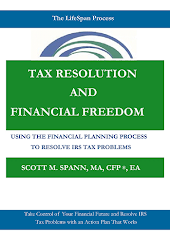
Trying to find the best way to resolve tax problems can be a difficult process. Writing about the best practices to help taxpayers is also a unique challenge. When I started the project of writing a book on tax resolution planning I had a simple goal in mind. I wanted to present an overview of how to use the tax and financial process to deal with tax problems. However, I quickly noticed that very few tax and financial planning professionals actually provide comprehensive financial counseling and planning for a group of people that needs help the most. While exploring this specialized area of tax and financial planning, I have learned a great deal about my own approach to the tax resolution process.

My conclusion is quite simple. The ideal solution to tax and financial problems includes a dual focus on tax resolution and financial planning. Rarely are both disciplines combined in an effective manner. Resolving IRS tax liabilities by using fundamental principles of the financial planning process is the most effective way to deal with tax problems. The use of these same principles is also needed to prevent future IRS tax problems.

One thing that I realized during my research and practical application of this approach is that comprehensive financial planning does work for people with federal and state tax liabilities. However, tax resolution planning is a unique process that needs to be structured in a way that increases the likelihood that someone with significant tax issues related to financial management problems will actually succeed in taking control of their situation.

The LifeSpan Process of Tax Resolution and Financial Freedom combines the fundamental principles of tax and financial planning in a holistic manner that focuses on the psychological and behavioral aspects of managing money and taxes. Simply put, most other approaches to tax problems only deal with the elimination of tax debt rather than the elimination of poor financial decision making. In order to achieve freedom from tax debt you must start with a plan that emphasizes smart financial decisions. When the tax resolution process is performed the right way it always places the focus on “big picture” issues.

Give LifeSpan Financial Planning, LLC a call at 1-877-TAX-9110 if you have any questions regarding tax resolution planning.

Scott M. Spann, CFP, EA
scott@lifespanplanning.com

Wednesday, April 8, 2009

Common Traits of Millionaires and Financially Secure Individuals

Financial change requires the understanding of past financial behaviors to figure out what needs to be changed. The development of positive financial behaviors will allow change to happen. This new approach to life and financial planning means there is a need to have models of success. It is generally not good to only place the focus on negative financial behaviors. That is the old way of approaching tax and financial matters. Instead let us shift our focus to positive models of success. Based on the work of Thomas Stanley’s "The Millionaire Mind", I have selected a set of positive behavior patterns of wealthy and successful individuals.

An analysis of the personality traits of millionaires and financially successful individuals is more than relevant during the tax and financial planning process. It is required. In order to achieve tax resolution and financial freedom you need to be able to identify some of the most common characteristics of people who have already accomplished success. You also need to strive to possess these qualities.

As you read these traits ask yourself if you possess these qualities. Be honest with yourself as you assess your internal resources. On a personal level I try to ask myself these same questions any time that I am faced with a major life decision.

If there are a few areas that are in need of improvement write them down and make a list of ways that you would like to improve. Keep in mind that you are not expected to currently possess all of these traits. However, the closer that you can get to 100% of these traits the easier your journey may be. Here are three of my favorites that were highlighted in "Tax Resolution and Financial Freedom".

1. Integrity

“Integrity is doing the right thing, even if nobody is watching.” - Author Unknown

Successful people never sacrifice their integrity and are always honest with themselves and others. If you behave with a high degree of personal integrity you have a greater likelihood of financial success. Most importantly, you will live a life of strong resolve and consistency. There are many wealthy individuals in this country who have amassed large sums of wealth through corruption and deception. The acquisition of wealth without integrity is not a sign of success. True financial success requires high standards of integrity through good and bad times.

2. Courage

“Promise me you'll always remember: You're braver than you believe, and stronger than you seem, and smarter than you think.” - A.A. Milne

“Courage is resistance to fear, mastery of fear - not absence of fear” - Mark Twain


Change requires personal sacrifice. To live like nobody else with a sense of financial freedom requires the courage to take risks and live like nobody else until you reach your goals. Often successful people are risk-takers, but more importantly they are courageous. They tap into the courage that lives deep inside them and use it to break ground, try new things and put themselves out in front. When making a commitment to learn new strategies and techniques you are taking risks.
It takes courage to admit failure and pick oneself off the ground and try again at anything in life. Courage is also needed to change one’s approach to taxes and finances. Some of the most successful people in this world have failed time and time again only to get up again and display the courage needed to accept the next challenge in life.

3. Willingness to Act

“Faith means belief in something concerning which doubt is still theoretically possible; and as the test of belief is willingness to act, one may say that faith is the readiness to act in a cause the prosperous issue of which is not certified to us in advance.” - William James

Knowing and doing are two separate things. The key ingredients of tax and financial freedom include three parts behavioral change and one part knowledge and expertise. Knowing what to do during the tax resolution process is important. Having the willingness to act on this knowledge is more important.

Successful people are willing to dig in, do the work and learn new things. They are simply willing to do whatever it takes to create the life they want. TAKING ACTION is a core theme throughout the Tax Resolution and Financial Freedom Process. Be willing to take the steps needed to improve your financial life.

-Scott Spann
LifeSpan Financial Planning, LLC
(843) 469-3505

Friday, April 3, 2009

Psychology of Money

I would like to take a slight detour from the traditional tax and financial planning advice that will generally appear in this blog. I will not deny that the facts, figures, statistics and supporting information related to the various aspects of our financial lives are all quite important. However, one critical area of importance that most financial planners and individuals do not typically address when dealing with tax and money matters is the “psychology of money”.

Is financial planning really all about money? I do not think so. A growing number of financial planning professionals including myself have adopted a holistic approach to the planning process. In general, this means looking at the whole person during the life planning process rather than simply focusing on their financial lives. I strongly believe that the “inner game” of money should not be ignored. It is human nature for our belief systems, attitudes, past experiences, goals and values to have an influence on key financial planning and life decisions. The traditional view towards financial matters is based on rational decision making. In reality, people do not always behave rationally when personal finances are involved.

According to the Certified Financial Planner Board of Standards Inc., more than 40 percent of Americans feel that they are not in control of their finances. Financial planning is about taking control of your finances and is often defined as the process of meeting life goals through proper management of your money. Most of us agree that it is essential to have a plan to guide us through money related decisions. Unfortunately, many people for lack of a better term get “stuck” and never truly start the planning process. That is where principles of cognitive-behavioral psychology relate directly to financial matters.

What is keeping you or someone you know from establishing or implementing a financial plan? Since most everyone will agree that a financial plan is important, the real issue is how to get started. A written plan can provide direction and guidance and reduce or eliminate money-related stress. During these uncertain economic times you can either choose to “panic” or start to “plan”.

Here are some basic tips to get started with the financial planning process if you ever find yourself “stuck”:

1. Do not wait for the right time to establish a plan. It will never happen. Set a specific date and time to review your finances and stick with it. If married, work together with your spouse and communicate openly and honestly.

2. Start with the creation of a Personal Spending Plan (a.k.a. “budget”). Tell your money where to go before the month begins rather than trying to figure out where it all went when the month ends. Use an envelope system to control spending.

3. Next, establish a plan to get out of debt. Avoid high interest consumer debt (e.g., credit cards, installment loans). Pay off your high interest consumer debt before investing.

4. Establish an emergency fund with at least 3-6 months basic living expenses. This should be completed prior to starting any long-term investment plans.

5. Once you have a fully funded emergency savings fund in place you are ready to start building wealth. Try to set aside at least 15-20% of your total income for investments. Tax advantaged retirement accounts should generally be funded first. While you may not be able to invest 15-20% of your income at first you should always use the spending plan process to save and invest as much as possible for your life planning goals.

These tips may sound very simple but they are the most important financial planning concepts to follow if you are just getting started with the planning process. Improving your financial life and using money to help reach important life planning goals is 75% behavioral and 25% knowledge and expertise. Start thinking about the psychology of money and you will be a step closer to meaningful change. The basic financial behaviors of planned spending, debt avoidance, and routine savings are the building blocks for financial freedom.

Scott M. Spann
scott@lifespanplanning.com
(843) 469-3505