Do you owe back taxes to the IRS?
Are you behind with filing tax returns?
Is dealing with tax matters becoming frustrating or overwhelming?
Or…
Are you compliant with your tax obligations but would like to establish a plan to minimize the impact of future income taxes?
If you have tax problems, what is the ideal solution for your tax struggles? The answer depends on the “big picture” of your financial situation. There is no one option that is the best choice for each person. A one size fits all approach does not work with tax resolution. The IRS simply wants to ensure that you pay your tax obligation and they will take various measures to make sure you do so according to their terms. It is up to you, the taxpayer (with some professional guidance), to make smart financial decisions when choosing among your tax resolution alternatives. Keep in mind that the IRS is essentially the accounts receivables department of the U.S. Government. Their job is to make sure that everyone that should pay taxes does. If a taxpayer is not compliant with IRS procedures they have the authority to collect.
The Internal Revenue Service does not necessarily care that you choose the best tax resolution option available. They simply want to ensure that you pay your tax obligation and they will take various measures to make sure you do so according to their terms. It is up to you, the taxpayer, to make smart financial decisions when choosing among your tax resolution alternatives.”
The bottom line is that avoidance is not an option. Take control of your tax problems, and while you are doing so assume control of something more important- your total financial situation. There are many options available during your quest to deal with resolving a tax liability. However, taking control of your life by establishing a financial plan is NOT an option…it should be viewed as a requirement if you truly want to reduce your financial stress and get on with your life on your terms (not the IRS’s). Remember, the IRS is interested in one thing during the collections process and that is collecting taxes that are past due.
If you are faced with the task of dealing with a past due tax liability, you need to understand how to organize your financial life in order to deal with the IRS in the most effective manner. This means putting your goals and objectives first and being proactive. Engaging in the financial planning process is your best option as you begin the journey to tax resolution with the IRS. Tax debt inhibits freedom. It distracts you from other more important goals and objectives.
Debt is Dumb. Tax Debt is even Dumber if not dealt with immediately. Resolving tax debt without a plan is not a smart decision. Tax resolution requires a plan. The tax and financial planning process is the solution to resolve tax problems.
Scott M. Spann, CFP(R), EA, MA
Financial Life Planner
LifeSpan Financial Planning, LLC
(877) 829-9110
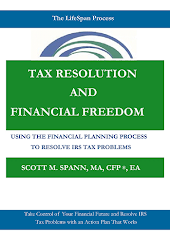
For more information on the LifeSpan Process of Tax Resolution and Financial Freedom, contact Scott toll-free at 877-TAX-9110. LifeSpan is currently offering complimentary copies of the book "Tax Resolution and Financial Freedom" to everyone that schedules a free Tax Resolution Analysis before July 4th.
Monday, June 22, 2009


Tuesday, June 16, 2009
Why is the term "Fee Only" so important?
The term "Fee Only" refers to the way financial planners are compensated for the advice they provide. This term is growing in popularity, but many individuals in the financial services industry use this term inappropriately. In addition, if you ask the average person what it means to work with a Fee Only financial planner they may not fully understand the critical importance of the term.
The National Association of Personal Financial Advisors (NAPFA) defines a Fee-Only planner as "one who, in all circumstances, is compensated solely by the client, with neither the advisor nor any related party receiving compensation that is contingent on the purchase or sale of a financial product". This type of professional relationship always places the clients best interests first and eliminates potential conflicts of interest. Fee Only compensation indicates that an advisor never accepts commissions or compensation of any kind related to the products he or she recommends.
I strongly believe that Fee Only planning is extremely important during these uncertain economic times. A financial planner who has a financial stake in the course of action that he or she recommends to a client faces an inherent conflict of interest and cannot be considered objective and unbiased. This is true even if the planner truly believes that he or she has only the best interests of the client at heart.
Unfortunately, the vast majority of financial advisors in the United States are sellers of financial products. There is nothing wrong with the presence of product based advisors. Their services are needed and many do indeed try to do the best for their clients. Some or all of their income may be dependent upon their ability to steer their clients to a limited number of the thousands of financial products available today. Putting aside the conflict-of-interest factor, this limiting of choices, in and of itself, often is enough to impact the quality of the investment advice.
A Fee Only financial planner is well-positioned as an objective source of tax and financial planning advice. I agree with NAPFA's belief "that many of the problems that beset Americans today in their financial affairs – including the mis-management of debt, failure to protect retirement assets and poor allocation of savings and investments – relate directly to the conflicts of interest that pervade the marketplace". If you are in the process of taking control of your financial life, consider working with a Fee Only financial planner to guide you along the journey to tax and financial freedom.
Scott M. Spann, CFP(R), EA, MA
LifeSpan Financial Planning, LLC
877-829-9110
For more information on Fee Only planning visit www.napfa.org or www.focusonfiduciary.com.
The National Association of Personal Financial Advisors (NAPFA) defines a Fee-Only planner as "one who, in all circumstances, is compensated solely by the client, with neither the advisor nor any related party receiving compensation that is contingent on the purchase or sale of a financial product". This type of professional relationship always places the clients best interests first and eliminates potential conflicts of interest. Fee Only compensation indicates that an advisor never accepts commissions or compensation of any kind related to the products he or she recommends.
I strongly believe that Fee Only planning is extremely important during these uncertain economic times. A financial planner who has a financial stake in the course of action that he or she recommends to a client faces an inherent conflict of interest and cannot be considered objective and unbiased. This is true even if the planner truly believes that he or she has only the best interests of the client at heart.
Unfortunately, the vast majority of financial advisors in the United States are sellers of financial products. There is nothing wrong with the presence of product based advisors. Their services are needed and many do indeed try to do the best for their clients. Some or all of their income may be dependent upon their ability to steer their clients to a limited number of the thousands of financial products available today. Putting aside the conflict-of-interest factor, this limiting of choices, in and of itself, often is enough to impact the quality of the investment advice.
A Fee Only financial planner is well-positioned as an objective source of tax and financial planning advice. I agree with NAPFA's belief "that many of the problems that beset Americans today in their financial affairs – including the mis-management of debt, failure to protect retirement assets and poor allocation of savings and investments – relate directly to the conflicts of interest that pervade the marketplace". If you are in the process of taking control of your financial life, consider working with a Fee Only financial planner to guide you along the journey to tax and financial freedom.
Scott M. Spann, CFP(R), EA, MA
LifeSpan Financial Planning, LLC
877-829-9110
For more information on Fee Only planning visit www.napfa.org or www.focusonfiduciary.com.
Monday, June 8, 2009
The Importance of Eliminating Debt from your Life
The presence of debt problems affects more than just the individual in debt. Tax and consumer debt can create additional strains on relationships with a spouse or other family members. Similar to most problems that go unaddressed over long periods of time, financial problems related to debt will compound if not eventually dealt with. This is undoubtedly the case with past due tax liabilities and related penalties and interest as well as other forms of problematic debt (e.g., credit cards, installment loans, etc.).
Biopsychosocial Impact of Debt (a.k.a. The Triple Whammy)
The presence of debt affects more than just the wallet. Debt problems can also create an increased risk of health, psychological, and social pressures. Engaging oneself in a debt reduction plan will do more than improve the finances. The following problems are associated with debt.
• Health Problems- Being in debt is associated with an increased risk of digestive track issues, migraines, and even heart attack. Other related problems are high blood pressure, insomnia, lower back pain or tension, and concentration problems.
• Psychological Problems- Anxiety, depression
• Social Problems- Marital tension and debt stress have a negative impact on relationships in general, trouble focusing on work can also result in poor productivity and increased problems at your workplace
A life without debt may seem difficult to imagine if you are one of the millions of Americans struggling financially. Debt will not go away on its own. Take action and create a debt management plan that puts you in control of your financial future.
Biopsychosocial Impact of Debt (a.k.a. The Triple Whammy)
The presence of debt affects more than just the wallet. Debt problems can also create an increased risk of health, psychological, and social pressures. Engaging oneself in a debt reduction plan will do more than improve the finances. The following problems are associated with debt.
• Health Problems- Being in debt is associated with an increased risk of digestive track issues, migraines, and even heart attack. Other related problems are high blood pressure, insomnia, lower back pain or tension, and concentration problems.
• Psychological Problems- Anxiety, depression
• Social Problems- Marital tension and debt stress have a negative impact on relationships in general, trouble focusing on work can also result in poor productivity and increased problems at your workplace
A life without debt may seem difficult to imagine if you are one of the millions of Americans struggling financially. Debt will not go away on its own. Take action and create a debt management plan that puts you in control of your financial future.
Friday, June 5, 2009
Money Matters Advisory Team
I will be a guest on the Money Matters radio broadcast on Saturday, June 6, 2009. The Money Matters Radio Show is hosted by Rick Durkee. The show airs in the Charleston, South Carolina market on Saturday mornings at 9:00 a.m. until 10:00 a.m. I will also serve as the Certified Financial Planner™ representative on the radio show's advisory team. Money Matters can be heard on 94.3 WSC FM in the South Carolina Lowcountry or on streaming live on the internet at www.wscfm.com. Archived shows are also available.
Be sure to tune in, I will be giving out free copies of my book "Tax Resolution and Financial Freedom" during the first segment of the show!
Scott M. Spann
LifeSpan Financial Planning, LLC
Be sure to tune in, I will be giving out free copies of my book "Tax Resolution and Financial Freedom" during the first segment of the show!
Scott M. Spann
LifeSpan Financial Planning, LLC
Wednesday, June 3, 2009
The Need for Emergency Savings
According to the National Foundation for Credit Counseling, one third of all Americans do not have any emergency savings- ZERO SAVINGS. Of those households that do have an emergency fund in place, only 43% have adequate savings available for emergencies. If you genuinely want to reach a state of financial liberation then you need to be different from the average person. As indicated above, the majority of people in this country have no emergency savings. Financial freedom requires being a renegade who approaches money matters in a unique way. Planning for unforeseen events and the unpredictable in life is not unique. However, in this day and age of negative savings rates and growing debt an emergency fund will go a long way in separating you from others who are seemingly content living in a world of debt.
Monday, May 25, 2009
How does the “Tax Gap” affect you?
The IRS and the Economic Policy Institute recently estimated the amount of taxes owed but not paid at $353 billion, equal to about 15% of the total taxes owed. These taxes not paid through our “voluntary and timely” system of taxation are often known as the “tax gap”.
Unpaid taxes mean that the average law abiding citizen is paying more than his or her fair share. If you are one of the millions that are not current with your taxes the tax gap has a different effect on you. The IRS is seeking to increase its collection efforts. Lawmakers will likely increase their pressure on the IRS to decrease the tax gap. Even with recent improvements the IRS is not moving fast enough in the eyes of many to improve the collection of back taxes. While the IRS recently acknowledged the need to be kinder and gentler in light of the recent financial crisis in our nation, they will not be as willing to deal with delinquent taxpayers that avoid collection efforts and ignore existing tax liabilities.
Congress and others are increasing their questioning of the effectiveness of the IRS collection processes. The IRS is currently implementing measures to improve its collection process. Currently, the IRS primarily focuses their collections efforts on a Three Phase Collection Process. Collection notices, phone calls, and in person visits are the three primary elements of the collection process. In 2007 the IRS sent 16 million collection letters to delinquent taxpayers. They answered 5.4 million incoming phone calls and made 1.9 million outgoing phone calls trying to collect on past due tax debt. In person visits are the final part of the IRS collection process. Over 400,000 contacts were made with delinquent taxpayers at their homes and businesses.
The IRS is constantly working to streamline its collection process. There are a number of reasons why IRS collection activities will continue to grow in the coming years:
• The struggling economy, growing national deficit, war on terrorism, and recent financial bailouts have created a situation where the government needs money badly.
• IRS collection efforts are needed and mandated by Congress to help close the tax gap.
• The IRS continues to hire new employees; the majority of these new hires focus on collections and enforcement activities.
• Budget increases are set to be spent on increased collections and enforcement.
• IRS Commissioner has stated that closing the tax gap is his number one priority.
The pressure on delinquent taxpayers will continue to increase as the federal government recently set in motion plans to increase its tax enforcement efforts in the coming years. In addition, new technology and information sharing among tax agencies make it easier for agencies to pinpoint potential offenders, increasing the number of cases for audit and collection. Tax and financial planning professionals are challenged with the task of helping their clients with tax liabilities resolve tax problems in the most cost-effective manner. A comprehensive plan that heavily emphasizes income tax planning can help individuals resolve their tax liabilities and accomplish other financial goals.
Unpaid taxes mean that the average law abiding citizen is paying more than his or her fair share. If you are one of the millions that are not current with your taxes the tax gap has a different effect on you. The IRS is seeking to increase its collection efforts. Lawmakers will likely increase their pressure on the IRS to decrease the tax gap. Even with recent improvements the IRS is not moving fast enough in the eyes of many to improve the collection of back taxes. While the IRS recently acknowledged the need to be kinder and gentler in light of the recent financial crisis in our nation, they will not be as willing to deal with delinquent taxpayers that avoid collection efforts and ignore existing tax liabilities.
Congress and others are increasing their questioning of the effectiveness of the IRS collection processes. The IRS is currently implementing measures to improve its collection process. Currently, the IRS primarily focuses their collections efforts on a Three Phase Collection Process. Collection notices, phone calls, and in person visits are the three primary elements of the collection process. In 2007 the IRS sent 16 million collection letters to delinquent taxpayers. They answered 5.4 million incoming phone calls and made 1.9 million outgoing phone calls trying to collect on past due tax debt. In person visits are the final part of the IRS collection process. Over 400,000 contacts were made with delinquent taxpayers at their homes and businesses.
The IRS is constantly working to streamline its collection process. There are a number of reasons why IRS collection activities will continue to grow in the coming years:
• The struggling economy, growing national deficit, war on terrorism, and recent financial bailouts have created a situation where the government needs money badly.
• IRS collection efforts are needed and mandated by Congress to help close the tax gap.
• The IRS continues to hire new employees; the majority of these new hires focus on collections and enforcement activities.
• Budget increases are set to be spent on increased collections and enforcement.
• IRS Commissioner has stated that closing the tax gap is his number one priority.
The pressure on delinquent taxpayers will continue to increase as the federal government recently set in motion plans to increase its tax enforcement efforts in the coming years. In addition, new technology and information sharing among tax agencies make it easier for agencies to pinpoint potential offenders, increasing the number of cases for audit and collection. Tax and financial planning professionals are challenged with the task of helping their clients with tax liabilities resolve tax problems in the most cost-effective manner. A comprehensive plan that heavily emphasizes income tax planning can help individuals resolve their tax liabilities and accomplish other financial goals.
Friday, May 8, 2009
Filing Past Due Tax Returns
If you filed your tax returns on time the April 15th filing deadline may seem like a distant memory. However, if you filed an extension or missed the filing deadline, the idea of filing a past due tax return should be fresh in your mind.
If you have tax returns that need to be filed you are not alone. It is not uncommon for some taxpayers to go one or more years without filing a tax return. Many times I have seen that a taxpayer fails to file a tax return in a year when financial and life circumstances changed. For reasons related to procrastination, fear, lack of funds, or any other combination of factors a tax return was not filed. An amazing thing happens at first when a tax return is not filed within the system of voluntary compliance- Nothing! Sometimes weeks, months, and years may pass before the IRS requests a tax return or issues a tax assessment for a previous tax year.
Whatever the reason for not filing, tax problems only get worse if a non-compliant taxpayer starts worrying about his or her financial situation but does nothing to change the problem. Everyone has reasons and a life story that explains why a tax return was not filed. It is important to understand and address your individual reasons to avoid future filing problems. The tax resolution process is focused on the future and moving forward. Try to not dwell on your past mistakes or reasons for not filing a tax return. Focus on taking action and following the tax resolution steps.
Scott Spann
LifeSpan Tax Resolution
(877) TAX-9110
If you have tax returns that need to be filed you are not alone. It is not uncommon for some taxpayers to go one or more years without filing a tax return. Many times I have seen that a taxpayer fails to file a tax return in a year when financial and life circumstances changed. For reasons related to procrastination, fear, lack of funds, or any other combination of factors a tax return was not filed. An amazing thing happens at first when a tax return is not filed within the system of voluntary compliance- Nothing! Sometimes weeks, months, and years may pass before the IRS requests a tax return or issues a tax assessment for a previous tax year.
Whatever the reason for not filing, tax problems only get worse if a non-compliant taxpayer starts worrying about his or her financial situation but does nothing to change the problem. Everyone has reasons and a life story that explains why a tax return was not filed. It is important to understand and address your individual reasons to avoid future filing problems. The tax resolution process is focused on the future and moving forward. Try to not dwell on your past mistakes or reasons for not filing a tax return. Focus on taking action and following the tax resolution steps.
Scott Spann
LifeSpan Tax Resolution
(877) TAX-9110
Subscribe to:
Posts (Atom)



 Posts
Posts